Wednesday, March 14, 2012

Springing

The apricot tree is in full bloom and full buzz.
Coming in for a landing.
I noticed the blooms this morning and went out to see what was going on. Honey bees are having a fine time harvesting pollen and nectar. I hope this means lots of apricots later on.

It feels more like May than March... sunny, breezy and 83 degrees. The frogs are singing. The chickadees are calling back and forth in their spring mating ritual. The daffodils and narcissus are splashing sunshine all over the garden.

Look at those full pollen bags!
The cabbage, kale and brussels sprouts seedlings have been living outdoors full time for the last few days and they get bigger every day. Next week, when I hope to be able to put a bit of weight on my broken foot, I will plant them in the garden, along with some lettuce starts and maybe even the celery. I just hope we don't get a surprise freeze.

The elderberries are showing bits of green and the blackberries are starting to put on some leaves. The parsley is greening up and the elm flowers have given way to green leafy stuff.

Spring may have arrived plenty early, but I am not concerned about the warm weather. I have seen unusually warm springs turn into cool and damp summers. I am looking at this as an extra long growing season.

No sense in anticipating something bad, just Enjoy it!

Narcissus nodding in the wind.

A Bone to Pick

A broken fifth metatarcil may impede some of my gardening plans, but I have crutches, a rolling desk chair and an apron with large pockets for carrying things. I am mobile, at least and can do a few things. The orthopedist said I could possibly bear weight on the foot in a week, but it will take a couple of months to heal. And even then, a few things will be out of the question for several months.

It is interesting to note that prior to my mishap, I was looking at ways to maintain and improve bone health through foods and herbs.
How the young nettles looked a week or so ago.
 The stinging nettles, Urtica dioica, are coming up now and they will provide many nutrients to nourish my bones, as well as the rest of my body. Nettles often are used in herbal blends for bone health. Nettle is quite rich in calcium and magnesium, both minerals important to strong bones. Nettle also contains good amounts of other minerals and vitamins.

The sting of nettle leaves and stems disappears once the plant is cooked or dried, but I have only a mild reaction to the plant's formic acid contained in little hairs on the leaves and stalks, and even in the roots. Some people have more robust reactions. The juice of any dock species (Rumex) serves as an antidote to the nettle sting. Just crush dock leaves or stems and apply the juice. Plantain also will provide some relief. Some other Urtica species give a wallop far greater than this helpful plant, including one tropical species that can be fatally toxic.
How nettles look now.

Humans have used nettles for thousands of years as medicine, food, animal fodder and fiber. Nettle is a great nourisher for women, enriching the blood and other areas of the body. According to Susun Weed, some menopausal women have had their menses return after frequent use of nettles. I had intended to take advantage of the spreading patch of nettles at the back of my garden this year, to nourish my glandular system and tone the whole body. Now my need for healing highlights my need for this herb. Nettle has so many uses in nourishing and healing the body that it would take a lot of blog to cover them all here. I highly recommend that you find a copy of Susun Weed's "Healing Wise" and read what she says about nettle. I also will try to add information in future blogs.

Mature nettles sporting their tiny flowers.
Comfrey leaf.
Another bone-healing herb that grows in my garden is comfrey. While frequent internal use of large doses of comfrey can cause liver damage, many herbalists use this herb in medicinal amounts for short periods when healing is needed. Poultices of comfrey leaves also are recommended for healing bones and pretty much anything else, including open wounds. External use is apparently safe.

Comfrey provides a very energetic healing action. One should be absolutely certain that a wound is clean (be sure no infection is present, as well) and that broken bone ends are properly aligned before using comfrey for it will almost immediately begin knitting things together.

Unfortunately, it is too early to find comfrey leaves in my garden. I am taking homeopathic comfrey, known as Symphytum (the genus name for comfrey), which was recommended by a friend. I also purchased some dried comfrey leaf and horsetail (Equisetum) to make a bone nourishing tea.

Both comfrey and nettles are easy to grow. Too easy perhaps. You must be sure that you plant nettle in a place where she can run to her heart's content. Nettles are related to mints, and expand their territory by underground rhizomes. Once you plant comfrey, it is extremely difficult to move it out of the area. Essentially, you simple expand your crop, rather than move it, because its roots extend deeply and any piece left behind will become a new plant.

Comfrey in May.
Both of these plants also are good allies to garden plants. I cut them back in the summer and lay the leaves and stalks around the vegetables, where they will decompose and enrich the soil. They also are great additives to heat up the compost heap. Fermented "tea" made from them is a terrific liquid fertilizer, both as a root drench or foliar spray.

Bumblebees love to sip from comfrey blossoms, so this plant
supports this native pollinator.
I plan to greatly expand our crops of nettles and comfrey by planting them near and among the fruit trees, for which they will provide great benefits. One characteristic of nettles is that it improves the health of plants growing nearby, making them less susceptible to insect pests. Nettles also encourage certain beneficial insects. The large comfrey leaves serve as a living mulch, crowding out weeds and preserving soil moisture, as well as mining minerals from the soil with its deep roots and bringing them into the leaves. When the leaves die and decompose, they leave the minerals in the topsoil, where they are more available to the trees and other plants.

We also can use nettle hay to feed our chickens (when we get them), which not only will make the hens healthier but make their eggs a richer food source for us.

It is amazing to know that these two hardy, robust and easy to grow plants are so nourishing to myself and my gardens.

Sunday, March 11, 2012

Spring Interrupted

Rain today. I can see it out the window, falling lightly from a pale gray sky. The fire in the stove warms me, a hot cup of green tea is at my side, the laptop is in my lap. I feel quite cozy and loved.

The rain will delay some of the spring chores a bit, but tomorrow's weather will be sunny and in the 70s. Tuesday is supposed to hit the 80s. So that delay won't be as long as the possibly broken bone in my foot.

While dancing this morning I did a leap and spin that I have done many times before. The dancing felt easy and fluid, my soul was rising... this was not a time when I expected to make a serious misstep. However, I came down wrong and I heard a sharp crack in my foot. I felt no immediate pain, and even now, after icing it well I feel no pain, but I cannot stand on my foot. Tomorrow I will try to see an orthopedist and get a verdict. Regardless of whether some broke or tore or whatever, I won't be dancing, shoveling or doing much walking for a while. Since it is my right foot, even driving will be an issue.

Forced inactivity at this time of year is quite frustrating. So much to do, so much to see. The daffodil buds I posted a photo of earlier are now in full bloom, but I did not shoot them yesterday and cannot get out there today. So no new daffodil photos. I didn't want to post without at least one photo, so I am sharing the one above of santolina and other lovelies from last summer. Looking at the sundrenched garden in bloom is soothing.

Nothing for me to do now but consume bone nourishing herbs and foods and avoid further injury of the foot. Then wait... I should be able to get around well enough in a couple of weeks to put the cabbages and such in the ground. And since my husband has started a new job that will allow him to be home much more, I won't have to go it alone. My blessings are too numerous to complain about this little interruption.

Friday, March 9, 2012

Peas a Poppin'

The peas are just beginning to show their tiny heads. I took a photo of the very tip of a pea sprout poking up this morning when frost was still on the ground. Later, in the afternoon, I caught this one holding its head up a bit higher.

The arugula, mizuna and even some spinach planted a couple of weeks ago with the peas also are sprouting. The only difference between these mizuna seedlings and the arugula seedlings is that the color of the arugula is darker. They are related, after all.

Today I set the seedlings of lettuce, onions and some herbs and flowers out on the porch to drink in the lovely weather, along with cabbages, etc. Space is getting tight on the light shelves, especially since I started some tomato and flower seeds the other day and potted up the peppers today. The eggplant and celery seedlings also need to be potted up, so they won't get stunted before it's time to put them in the garden.

A stroll through the garden reveals many new and wondrous things almost every day. The garlic is getting tall. More crocus, daffodils and tulips are popping up. The anise hyssop is showing fresh growth and the kale is sprouting new leaves on the stems killed back by single digit temps back in late January or early February.


I can hear spring rumbling through the earth. Look out! Here it comes!

Thursday, March 8, 2012

March Right In

Two things define March in Kansas: incessant winds and roller coaster weather.
For the past few days we have had the winds. Howling wind that continues into the night, making it difficult to stand sometimes and creating such energy that it can be difficult to sleep.
Then you have the roller coaster ride.

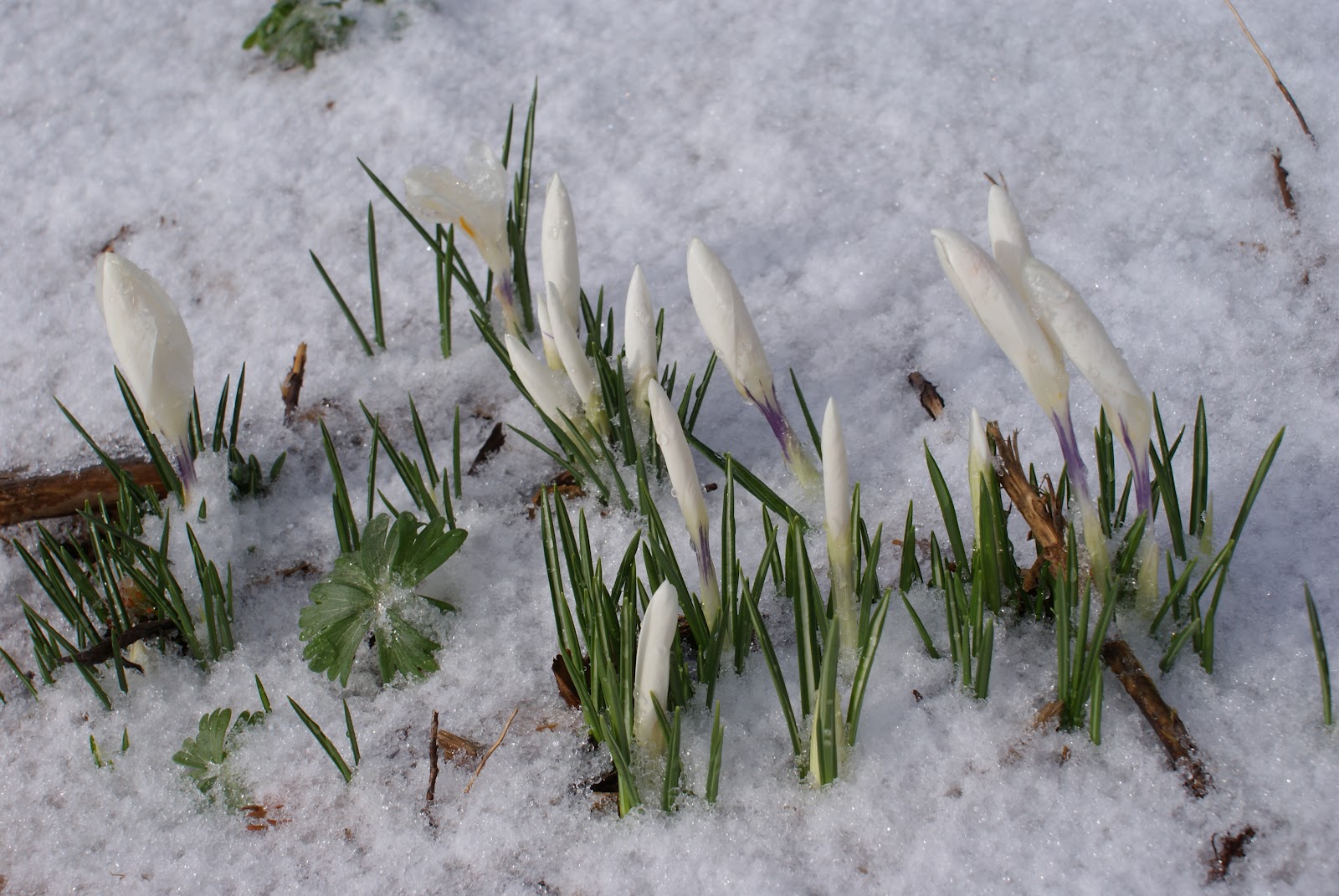
I took the above photo of a cluster of white crocus yesterday. Clouds covered the sky and the wind blew, but it was warm, with a high temperature exceeding 70. The air was humid in anticipation of rain.
The following photo of the same crocus group was taken this morning. Sleet had fallen overnight and covered the ground.

The icy pellets will melt this afternoon, as the temperature climbs into the upper 40s, and I will head out to gather my first harvest of nettles. By Monday, we will see upper 60s and 70s again.

I promise that today is the last day this year I will post crocus photos. Some of the daffodils are nearly ready to open.....

And the apricot tree is covered with flower buds.

I spoke with a neighbor last night and she said that her apricot trees were blooming already. I assured her that nothing would happen like last year when I had snow on my apricot blossoms. Ooops. I guess she has sleet-covered blossoms today.

Yesterday I finished (mostly) the pruning and training of the apple and pear trees. I kept the pear pruning minimal, as late winter pruning invigorates growth and pears tend to grow pretty vigorously already. All that lush, rapid, tender new growth is more susceptible to things such as fire blight, so I will prune out the excess in a few weeks, when pruning is less invigorating. Then we'll start pruning the apricot, cherries and other stone fruits.

The hardening off of cabbage and other brassica seedlings has started, to prepare the little plants for the move to their new home in a couple of weeks. Spring is springing!
 Below is a closeup of the elm tree flowers that have been feeding our honey bees.

Monday, March 5, 2012

Anticipation...

The elms buds I posted photos of earlier have opened into blossoms. On the not-so-windy days, the honey bees can buzz on up to the treetops to have their fill of pollen from these blossoms.

A variegated crocus has bloomed.

And so has a white crocus.

This fall I will plant crocus near the bee hive. A book on beekeeping noted that crocus provide an early flow of pollen and nectar. Because they are low to the ground, the bees can work them on cooler and windier days when they cannot reach the treetops for the offerings of the elm and black locust.

The work pace has become such that I no longer can afford time to do the Daily Green, although evidence of "the greening" comes more frequently.

We continue to prune and train apple trees. Today and tomorrow I will work on them alone, as the season is moving quickly. Not enough days in the week exist that my orchard partner can work with me to allow us to complete the job (together) by the end of this month. When that job is complete, we will wait a week or so, or maybe not all before we begin work on the stone fruits.

I also will start tomato seeds today. In a couple of weeks, the cabbages, et al, will go into the garden. The seedlings looked awfully puny when I potted them up last week, but they have grown since and, while still not very big, look more capable of surviving out of doors. The hardening off should begin soon... very soon.

Spring is on its way....

Thursday, March 1, 2012

(Almost) Daily Green

Opening......
A purple crocus has arrived! The season moves on. Next the variegated and white crocus will bloom, then the daffodils.
Opened!

The March winds arrived a day early yesterday... but then it was Feb. 29. Isn't that really March 1?

It was difficult to stand against the wind sometimes as we pruned and trained and mulched and expanded the deer cages around three more apple trees yesterday. The Tydeman's Late Orange apple trees were both perplexing (one yesterday, another a few weeks ago). That variety seems to tend to grow in strange ways. We also worked on a William's Pride and a Grime's Golden yesterday. William's Pride was a very nicely shaped tree, with well-spaced laterals. Its fruit does not keep long, however, so that will be the apple we must eat up first -- whenever we let the trees start producing.

Until tomorrow -- or the next day...
Dew on a poppy seedling.