Thursday, February 11, 2021

February Funk


My world remains locked in snow. 
It's not much snow, we might have gotten a bit over an inch after several days of snow. Unlike most northeast Kansas snows, however, it has remained on the ground for days. Usually sunny days follow a snow, at least after a day or two, and thawing ensues even if the temperatures don't climb above freezing but just hit the upper 20s.

This snow, however, was followed by the coldest stretch of weather we've had in years, and the forecast says it's about to get even colder. They say the sun will shine tomorrow, for the first time this week, although the temperature will remain in the single digits Fahrenheit and even fall below zero.
The bitter cold and cloudy skies don't do much good for one's mental state. I've been feeling scattered and distracted all week, unable to end the day feeling that I have accomplished much.
February is like that.
I started the month on a high note. I'd learned that some ancient cultures considered February a time of purgation, when they would conduct cleansing rites. So I decided to "purge" by doing some deep cleaning. I spent an entire day on our bedroom and master bath. Then moved on to the kitchen. I picked up an old writing project and refreshed that. Started organizing the recipes on my computer so I can print them out and tidy up the binder in which we keep recipes.
The first few days of that first week were a whirlwind, then my energy dropped, it picked up after a couple of days and then fell again. So this week I've kind of been at a standstill, although I feel that I'm doing stuff, I'm not just sitting around... sort of.
February is like that.
I find that getting outside helps me stave off the winter blues. This past week I've meant to get outside and wander around. My insulated overalls, heavy coat and work boots keep me quite warm, especially when I'm moving around. But highs in the teens and cloudy skies and February have kept me inside.
I do get outside a little each day though. Every morning and every evening before bed, and sometimes in between I step outside my back door without putting on a coat and stand for a few minutes just breathing fresh air. Feeling the cold, really feeling the cold and embracing it puts me in touch with the natural world around me. I feel more connected. 
Sometimes I go out barefoot, even stepping into the snow, my footprints alongside those of birds and rabbits. The biting cold of the snow reminds me that I am alive, washes away the numbness of dark February days spent indoors.
The amaryllis have quit blooming, but this little orchid  has 
stepped in to brighten the winter days. The blossoms last for
quite a long time.

I started the habit of stepping barefoot in the snow many years ago, when I went bobbing for apples on Halloween and came up with one in which an exclamation mark had been carved. I took that to mean I needed to get more exclamation marks in my life. Stepping barefoot into the snow certainly does cause some exclamations. It's invigorating, enlivening, exhilarating... I've begun to crave it.
I stand outside my back door on a 10-degree F. morning and sing to the wakening world. 
I stand outside my back door as the frost forms in the late evening and look for the moon and stars. Even if it's cloudy I search the sky.
I step barefoot into the snow and feel the cold bite as a freezing breeze brushes my face and seeps through my sweater. 
I breathe deeply of the bitter air.
I am at one, at peace with the frozen land around me bound by snow.
This gets me through February.
It gets me through.
I go back inside and check the tiny cabbage seedlings that will go into the garden in just six weeks or so. One more turn of the calendar page and I'm looking at planting season. But the planting has begun... cabbages, broccoli, leeks... Soon I'll start some lettuce, then eggplant and peppers, then... then...
Suddenly it's March.
This gets me through February... the "longest" month, when we are so tired of winter.
It gets me through.

Monday, February 8, 2021

We All Dig This Vegetable

Good morning from Spirit Bird Farm.

Everyone loves them.

Boiled, steamed, mashed, baked, and fried. In stews, in soups, in salads, as chips, for breakfast, lunch and dinner. They even turn up in desserts and other bakery goods in the form of starch and flour. For everyday meals, as well as holiday meals. Some of the best comfort food around. They've infiltrated nearly every one of the world's cuisines in about 500 years, although many Europeans initially thought they were poisonous. They are among the top most important food crops of the world, right up there with wheat, rice and maize (corn). They had become such an important crop in the 1800s that when Ireland experienced a widespread crop failure, famine ensued, killing maybe a couple of million people. A few decades later, Luther Burbank developed a variety resistant to the fungus that killed the Irish crop... potato blight.

Ah, yes, the ubiquitous potato. 

Let me take you back, to the very beginning....

The story of the lovely potato begins when the line that developed into our mashers split off from the parent line of the Solanaceae (nightshade) family a long, long time ago... 350 million years ago to be precise. Maybe not precisely. Dinosaurs weren't good at keeping records, what with their focus mainly being on eating other dinosaurs and/or NOT being eaten by other dinosaurs. They figure this out through deeply studying genes. I don't know how they determine it... by magic is my guess... but they can make a good guess.

Taters!

The story is foggy after that. But at some point the Incas or their predecessors in the Andes region of South America began gathering the tiny, but tasty and nutritious tubers as food, maybe as early as 8000 BCE. Archaeological evidence, however is not quite that old. I couldn't find reliable accounts of what the oldest archaeological evidence shows -- some sources said 3400 BCE, some 2500 BCE and one just 400 BCE. Regardless of the archaeological evidence, we know that the Andean natives have used and cultivated potatoes (about 20 different species) for a long, long time... developing thousands of varieties, most of which continue to be grown only in their native region.

Those early potatoes and many of those still grown in Peru, were much smaller than the large tubers of the species Solanum brevicaule now grown worldwide. In my search for information about potato's history, I found so much more written about it's introduction to Europe than about its use by the native people of South America. The Spaniards introduced the potato to Europe around the mid 1500s, but most of Europe resisted it as a food crop because of its relationship to the poisonous nightshades (the tomato also suffered this). 

The aristocracy of some of the European countries recognized the value of the potato as a food source, because of its nutritional and caloric density and its ease of growth. So they worked, sometimes using a little subterfuge, to convince the agricultural class to grow and consume potatoes. The little tricks worked, but for the most part potatoes were considered working class food, except in China, where it became a delicacy of the Imperial family. Go figure.

Then a little fungus caused the Irish potato famine, where it had replaced the rutabaga and turnip as a staple crop. And can you blame the Irish? I like turnips and rutabagas, but given the choice between them and potatoes... guess which wins.

So that's enough of that. You can find that stuff anywhere. But I had to look in a lot of places for info on the Inca use. The Incas apparently thought quite highly of their potatoes, even making pottery vessels in the shape of the tubers, which looked more like the fingerling varieties of today. They used them as medicine and possibly even in religious ceremonies. I believe that the ancient people of the Americas held their food plants in much higher regard than we do today, considering them spiritual allies. 

According to most of the history I found, the potato was first grown in North America in the 1600s, introduced by European settlers, of course.

However....

Recent archaeological discovery has uncovered that North American indigenous people used a species of potato more than 10,000 years ago. Starch grains on stone tools found at a site in Utah were identified as belonging to that of a potato, S. jamesii. That predates evidence of potato use in South America. What's more, that potato species still grows in North America, in the Four Corners area of Arizona, thus it's called the Four Corners potato. Indigenous people there still use the little tuber.

The next time you sit down to a helping of mashed potatoes, thank the Incas and their predecessors for discovering the delicious goodness of potatoes. They are "Inca" potatoes in truth, not Irish at all.

NOTE: I did not intend to make this blog post all about the history of potatoes. I was supposed to put some growing information in here. I promised the readers of my newspaper column a link to the K-State Research and Extension publication on growing potatoes in Kansas. So here is the growing potatoes link. It looks like I will need to do another post for all of you wanting to know more about growing them. Maybe I'll wait until I'm planting my own potatoes, for the first time in many years, then you can follow my experiences on that. Or I'll do my next post on them so I can let you know about their awesome nutritional value and tell you how to make the best baked fries.

Sunday, January 31, 2021

A Winter Garden


 We had a couple of pretty little snows last week, which were gone by the weekend when it rained all day. So the sun hasn't been out much for more than a week.

Yet it's bright inside here, where the amaryllis have put on quite a show.


They've already lasted a full week, although a few blossoms have faded. They will be around for most of this week, though.

We're also harvesting yummy greens during this gloomy time. Microgreens.

A few years ago I wrote two or three posts about microgreens, as I'd just started doing them. These were lengthy posts, first about how to grow microgreens, then how to deal with the fungus gnats and damping off that showed up. (I don't add the cinnamon anymore. No more damping off since I'm not reusing the soil. I still deal with fungus gnats, but not for long.)

While I was able to grow microgreens and get rid of the fungus gnats, my microgreen project wasn't perfect. I had trouble keeping them watered properly. When the little greens fell over because they wilted, they usually didn't stand completely tall after receiving water. My husband noticed that after being that way for several days some of the greens near the soil would get slimy. Not pleasant. I tried to be more diligent about keeping them watered, but it still didn't work quite right.

Red cabbage microgreens  about a week away from harvest.

I had been growing the microgreens in a solid bottomed flat and watering from above. But I learned that wasn't the best way to do it. (Obviously, because they were getting mushy.) Then True Leaf Market Seed Company, where I get some of my microgreen seeds and supplies, sent out its e-newsletter with a link to their microgreens growing guide. So, of course, I checked it out.

Aha! I should have put the soil in a flat with a slotted bottom, set inside a solid bottom flat. The soil needed to go into the flat dry -- I had been wetting it before putting it in the flat. After scattering the seeds on the soil and pressing them in, then it's time to wet the seeds and surface thoroughly with a spray bottle, cover the flats so they sprout in the dark. When they sprouts are half and inch or more tall (they'll be yellow green having sprouted in the dark) put half an inch of water in the solid bottom tray and set the tray with the soil in side, so the sprouts are bottom-watered and set them in the light. Then bottom water them from then on. I've found that once they get growing well I need to water them every other day. 

The growing guide I linked to above will give more detailed info. The first step on it is to soak the seeds, but you only need to do that with large seeds, like peas. I'm planting tiny seeds -- broccoli, brussels sprouts, kale, and cabbage -- so I don't soak them. I start new trays of microgreens as soon as I set the sprouted ones in light.

My husband is now much happier with the microgreens he eats every day. If you're craving fresh greens from the garden, try microgreens. It's a great gardening and fresh food hit, even in the middle of winter.


Friday, January 15, 2021

Flowers in January


The amaryllis are getting ready to bloom. The photo was taken a few days ago and now the stalks are much taller and the buds plumper. In a few more days the buds will show some color and by this time next week the large orange blossoms will trumpet their arrival. The larger amaryllis hasn't yet started sending up its flower stalk. It always blooms much later than the others.

I have had the amaryllis for at least 15 years. I started with two pots of them, obtained at different times. Through repotting and divisions those two have multiplied into five pots of amaryllis. It's pretty easy to get them to rebloom and their brilliant blossoms can take the gray right out of a winter's day.

Once they quit blooming, I'll cut off the flower stalks and keep them in the plant room, watering them regularly so the foliage remains healthy. When the weather warms and quits freezing this spring they will go out to their summer home on the north side of the house.There they will remain until the weather starts freezing again. A dim corner of the attached, unheated garage becomes their winter home and I all but forget about them. They need no light, no water. The foliage dries up and the bulbs go dormant. 

Six to eight weeks before I want them to bloom, I bring them back into the warmth and light and start watering them. You also can hold amaryllis bulbs in the cool, dry dark until the weather begins to warm in spring. Then you can take them outside to revive and set them among other flowers and herbs in the garden for a brilliant, tropical display. They prefer morning sun.

If you want them to bloom by the Solstice or Christmas, bring them in at least by early November. I had hoped to have blooms by New Year's Day, but for some reason didn't get around to bringing them in until almost mid-December. 

No worries, though. I am grateful to be able to look forward to the large bright blooms on this cold, blizzardy day. 

I also am looking forward to the arrival of the first shipment of seeds today. I am hoping that another one arrives soon, as some things, such as the onions, will need to be started before the end of this month. The leeks, too, but I already have the seed for those.

Some of the other seeds I am looking forward to won't be planted until August or September. Those include winter radishes. I covered them in my last post, but didn't talk much about different varieties, focusing on the purple daikons (because I still have lots of those in the refrigerator). I also had the long white daikons, as well as Sichuan Red Beauty, which is red clear through. I thought Baker Creek had stopped carrying the seed, but this year it is listed under simply "Red Beauty Radish." So, Yay. I've also got seed for watermelon radish, with pink flesh surround by a ring of white, and an outer ring of green. Quite stunning as a garnish or when used as a "chip." 

A radish I will plant for the first time this fall is the Shawo Fruit Radish. These roots supposedly are sweet enough to replace fruit during winter tea parties in Beijing. I am looking forward to testing this.

I also will try some other vegetables for the first time this year... or at least my son and his fiancee will. I ordered the seeds and will get the plants going for them. These are the Indigo Rose Tomato, a pretty little cherry type, and the California Reaper Pepper. The California Reaper is the hottest, edible pepper. The only one that is said to be hotter will kill you, so the grower says. For myself, I ordered the Atomic Grape Cherry tomato, a prettily striped oval shaped cherry type. Will it nudge out the Sun Gold? I will let you know.

P.S. At the time I wrote this, Baker Creek had closed their Web site so they could catch up with all of the orders they've received this year. Be patient. Other seed companies also are experiencing slow downs. The pandemic has spurred greater interest in home gardening so they are being overwhelmed with orders.


Monday, January 4, 2021

Radical Radishes


Purple daikon radishes sliced for dehydrating.

Here I am, in a new year. Let's see if I can keep the posts flowing in 2021. In this post I will try to "root" myself into a new habit of sharing with you all.

And so today I will write about roots.

Roots are amazing. Not that plants in general aren't completely awesome, but how many of you have really dug into the subject of roots?

The first thing to emerge from a seed is the tiny root, the radicle. Roots anchor plants into place. They absorb water and nutrients from the soil. They store water and nutrients for dormant times. They exchange nutrients with fungal mycelia. They set up symbiotic relationships with bacteria. Roots excrete substances into the soil that may benefit or harm other plants. Roots communicate with fungal mycelia and other plants. Roots sense things. At the very end of each growing tip roots possess sensory structures that guide the roots' grow away from harm or toward moisture, nutrients and beneficial relationships.

At least 50 percent of most plants' mass is in their roots, especially during the growing season when the plants send out hundreds, maybe thousands of tiny feeder roots, each tipped with a tiny "brain" directing growth. (Are you getting chills of delight? I am.)

Watermelon radishes on the left, spring/salad
radishes on the right.

I just thought you ought to know this before I started writing about a specific root -- radishes, especially winter radishes.

We pulled lots of winter radishes from the garden this fall/winter. Lots. Lots and lots. You can say we had a bumper bumper crop of fall-planted radishes.

You may wonder what we're going to do with all of those radishes.

As we've discovered, there's not much you can't do with winter radishes. 

We've got two crisper drawers of them for fresh eating. Using different colored the radishes allows us to create beautiful garnishes. Today I'm adding some to a stir-fry. We chunked, steamed and froze a lot of them. My husband likes to take steamed ones from the freezer, thaw, and mash with potatoes and seasonings. I baked slices and dehydrated them as crunchy snacks. A jar of fermented purple daikons sits in the fridge. I baked some smaller ones whole, oiling them, putting them in a casserole dish, covered and baked until done. They can also be roasted; sliced or chunked, oiled and spread on a cookie sheet to roast in the oven.

Radishes are very easy to grow, but give the larger ones a little space. I was instructed to space the purple daikons at three inches. Watermelon radishes, red beauty radishes and white daikons can also reach considerable girth, so space them well. Regular watering helps keep them crunchy. 

When the weather started getting cold, I mounded lots of hay over the radishes as they will stay fresh in the ground for quite a while. However, when I pulled the last purple daikons just before Christmas, some of them had obviously been frozen at the top. Usually they're still good, but if they've started to turn a little brown inside I discarded that bit. We had so many. I did not feel bad about composting some of them.

Winter radishes do not do well planted in spring. When the temperatures rise, they want to produce flowers and seeds instead of plumping up their roots.

One root fertilizer I learned about is made up of potato peels, banana peels and spent coffee grounds. Dehydrate the potato and banana peels and grind them (a food processor works better than a blender). Dry the coffee grounds and mix it all together. Scatter onto the soil before you plant your seeds. This homemade fertilizer provides potassium, nitrogen and other nutrients. If you have a lot, use it to fertilize other garden plants. We don't peel our potatoes, but get plenty of banana peels and coffee grounds, either of which can be used alone as fertilizer.

I posted about radishes a couple of years ago. There should be more information there.

I was curious about the difference between regular winter radishes and daikons (which are a type of winter radish), so I looked it up. Daikons tend to be a little larger and less "spicy" than other winter radishes. I can tell you that this is true. Winter radishes are much larger than and take longer to mature than spring/salad radishes. Spring radishes will mature in about 30 days, as a rule, so they can be planted about two weeks apart maybe three times starting in early spring. Plant the winter radishes in late August later. Some you can harvest small at 30 days, let them go longer for larger roots. They grow best in cooler weather. If you leave them in the ground too long, they will get pithy, although the last purple daikons, planted in August and pulled late December, were not pithy. Some of the red beauty radishes were (planted August and the last ones pulled early to mid-December).

This fall I don't think I'll plant quite so many winter radishes.

Then again, with all the ways we've discovered how to use them. Maybe I'll do it again.


Monday, October 26, 2020

Tucking the Garden in Against the Cold


This view from my back door three weeks ago shows two seasons. The zinnias and amaranth coloring the middle ground are remnants of summer. Autumn shows itself in the red of the sumac leaves at the edge of the woods in the back, the thinning of the tree leaves, and the robust kale in the foreground, along with the white tunnels (barely showing to the left) protecting cabbages and lettuce of the autumn/winter garden.

A few days after I took the photo, the sumac dropped its leaves and the trees were more bare. The weather, though seemed more like late spring or early summer. We were hoping for some light freezes to sweeten the kale and cabbage. We did have a couple of frosts, but not freezes. Then early last week I looked at the forecast and nearly panicked. Snow and ice today and a low of 20 degrees Fahrenheit tomorrow (Tuesday) morning were expected.

This was the scene today. One season. Winter.

The kale is now under cover, as are  other autumn/winter vegetables.
Twenty degrees is awfully cold and would damage pretty much all of my autumn/winter crops without protection, even though they are considered "cold hardy" and "frost tolerant."

I started my three days of protecting my preciouses on Thursday. Winter seemed so far away as the sunny day temp climbed into the mid- or upper-80s. In the morning I faced the day with some dread. The job ahead seemed so enormous. But I got a lot done that day, easing the pace for the following two days.

I spent those three days tearing apart hay bales, piling hay around vegetables, and covering them with a heavy row cover (frost blanket) designed to give a few degrees of protection against cold -- over many things, two layers. The rutabagas got just hay, because I'm only concerned with protecting the roots. Most root vegetables will remain good in the ground, under a heavy mulch of hay, even though their tops might be killed. You can then dig or pull them through the winter, as long as the ground does not freeze.

Once I felt that everything was safe and cozy I began to wonder just how cold hardy all those vegetables were. 

Most of the Web sites I visited had two lists that varied only slightly: one list was for vegetables damaged with a light frost (28-31 degrees Fahrenheit); and the other those damaged by a hard frost, 25 to 28 degrees.
Just a pretty picture: Pink celosia in the snow.

But being a little damaged by low temperatures is not the same as being left inedible or dead. Then I stumbled across a blog by a woman (I'm sure I saw her speak once, at a Mother Earth News Fair several years ago) who, over several years, documented the temperatures at which various vegetables were killed. Blogger and author Pam Dawlings has decades of farming experience and for 20 years was the manager of the vegetable and berry gardens at the Twin Oaks Community in central Virginia. I was happy to see her information because it eased my mind; my efforts will most certainly keep my veggies safe tonight.

Rather than repeat her information, you can read the blog yourself. Some of the vegetables she noted as remaining alive until really cold temps in the teens I grow, such as Red Russian kale and Merveille des Quatre Saisons lettuce. They'll be just fine.

In a few days, temps will warm considerably and I can remove some of the row cover and see my beautiful vegetables again. And I'll sleep better tonight.


Sunday, August 2, 2020

We Are Not Alone

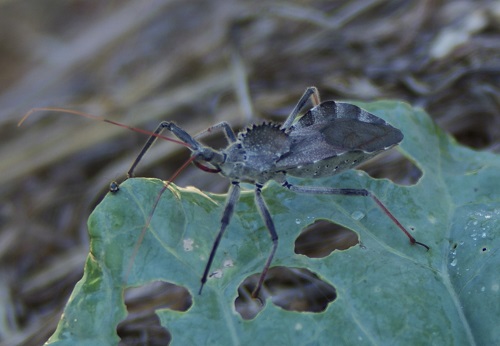
One of the many tenants of our place, a wheel bug searching for a green caterpillar to munch on. These guys are numerous
this year. They are everywhere I look. They also enjoy walking along the edge of the brim of my garden hat.
Carrying a large basket filled with freshly picked collard greens I headed toward the back door. Before reaching the stone steps I paused.
"Oh shit."
I marched into the house and said, "We've got another one."
My husband knew what I meant.
I donned my work boots and we went outside to catch ourselves a snake, a venomous copperhead snake. They live on the rocky, wooded hillsides that surround our house. We know they are there, and don't worry. They are welcome there, but not in the gardens, and certainly not in the terraced flower garden that wraps around the house.
As I'd walked from the garden I'd noticed the copperhead curled on a large stone at the bottom of the terraced garden. I think it noticed me when I saw it, because it seemed to recoil slightly, but did not move away.
We had captured and relocated another copperhead just a few days early, so the snare, a board and a five-gallon bucket had been left by the back door -- just in case.

One thing you learn quickly when you live in the country, especially with woods all around is that you are not alone. This is not "your" place. It belongs to all the creatures that live there and they care nothing about your rules, your "supposed to..."

A few days earlier I had stepped out the back door to go cut some herbs for tea when I noticed a tall piece off grass sticking up out of the patch of oregano by the steps. I reached over and pulled the grass easily from the soft soil. Just after the grass came free a copperhead slid through the oregano and into a space in the stacked stone terrace wall.
I felt no shock of adrenaline, just, well, I'd call it chagrin. That's the best word I can find.
"No, no, no. You're not supposed to be here. You're supposed to stay in the woods," I said.
But what do wild creatures know of human rules? "Supposed to? What does that mean?"
A little later, the snake showed itself and we attempted to capture it, but it disappeared into the rocks again.
The next morning my husband came in and said, "Let's catch ourselves a snake."
We got it, but not without a struggle. It had come only halfway out of the rock wall and when we tried to pull, it snugged itself in tightly. I felt nothing but compassion and love for this terrified creature -- a great change since the first time we encountered copperheads here.
The snake finally went into the bucket, I clapped on the lid and we took it for a ride, to a place where the creek comes close to the road, and set it free. I blessed it as it moved away. We also were successful in relocating the second snake and have encountered no more, although I scrutinize the flower garden every time I am on that side of the house, looking for the coppery markings.

Flutter, flutter.

We are not alone. I am reminded of that every day. Birds sing songs of love and competition. Vultures glide against the clear blue sky. Geese filled our little pond in early spring. Frogs sing at night. Toads hide in the damp soil of my potted porch plants. Bees hum busily at the flowers and butterflies flutter, flutter, flutter by. Rabbits dance in the clearings in the evening and dig, dig, dig in the mulched garden paths at night. Raccoons (or opossums) feast on cantaloupe the day before I plan to harvest it. Squirrels steal peaches and apples.

So I make adjustments. Chicken wire fences surround the vegetables most likely to be eaten by rabbits. A five-gallon bucket is upended over a nearly-ripe cantaloupe and weighted down with a rock (a bigger rock this time) to thwart midnight thieves. (Still haven't figured out how to thwart squirrels.) I plant flowers for the bees and butterflies. When I worked to clear away nearly finished compost and found snake eggs (most likely black rat snake; copperheads give live birth) I worked around them and left the eggs as undisturbed as possible. I hope they are still viable. Supposedly, black rat snakes help keep venomous snakes at bay, as well as catching mice and rats and baby rabbits. Life has its checks and balances.

We are not alone. Even though sometimes the critters here can be a nuisance, they are part of this land. They belong here as much as I do, maybe more so. I can't claim ownership of this place. That's a human thing, and not even all humans believe in ownership of the Land. Animals don't honor property lines.

We are not alone. I am not in charge, definitely not in control. I can only manage things.. a bit. I'm the only one who cares about my "rules." Nature has her own rules and I must abide by those, as well.

We are not alone.

And I am glad of it.