 |
| Black rat snake high up in a goldenrod plant in front of the house, waiting for the sun. |
|
| Black rat snake high up in a goldenrod plant in front of the house, waiting for the sun. |
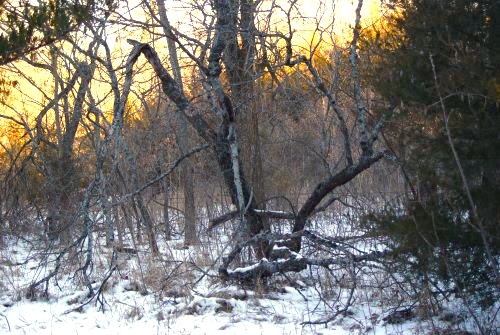
There is beauty yet in her decay, life in her death.
Highlighted in snow, one last bow, perpetual, until she collapses into decay.
There is beauty here, yet. Life in her decay.
A rotting corpse feeds the tiniest ones, which in turn feed roots and seeds, feeding stems and leaves.
A single tree no longer one, continuing to live on in many.
The magic, the beauty of the cycle.
Beauty, life, from one many, and on.
PS The day before this photo, when I first saw her, her arms held more snow and made a more striking scene. She was more obvious. But there yet is beauty here.
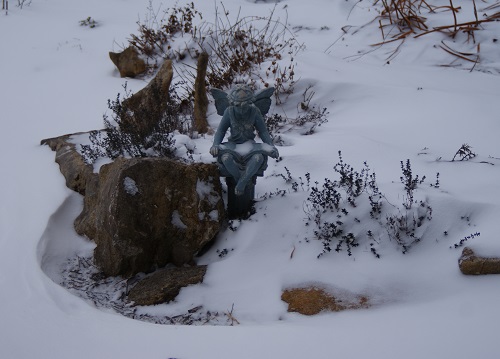
I went for a walk in the woods, looked for animal tracks (deer, birds, house cat, mouse?), hugged a giant Osage orange tree, and watched the snow that had collected on branches of the red cedar trees melt, sparkle and glitter as it dripped in the sunlight. I came in with twigs and red cedar leaves stuck in my hair. A great afternoon.
In my last post I noted that the germination test on the leek seed was a resounding success. It looked as if all of them had sprouted. Since it's about time to start my leek plants, I planned to go ahead and plant them.
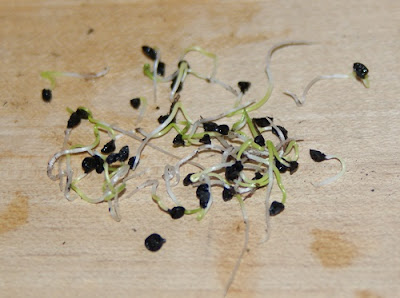
Initially I made the little holes with my fingers, and then decided I needed a tool. A chopstick works
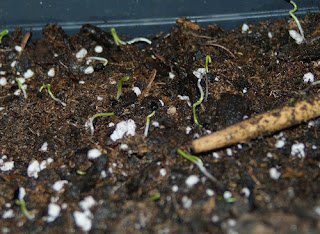
On that same day I started germination tests on some other seeds and checked them yesterday.
The six-year-old Orangeglow watermelon seed germinated 100 percent, it looks like. This seed I collected from watermelon growing in my garden. I am not sure what melons from this seed will be like. I first planted Orangeglow in 2014, along with at least one other melon variety and they likely cross-pollinated. A melon somehow got missed, or I spit seed into the garden, not sure, but a watermelon vine or two grew there the next year. I didn't realize it had produced any melons until I started clearing away cover crop. It was a huge melon, orange and sweet inside.
But I can't depend on that being the case when I plant these seeds. We will see what comes of these.
I will stick a few of these sprouted seeds in a pot and hope I have a nice little melon plant or two when the Extension Master Gardeners Garden Show comes around in two months. I'm in charge of the Edible Garden table.The watermelon plants might be too leggy and pale for a nice display along with the cabbage plants, tomatoes, peppers, lettuce, nasturtiums and begonias. (Begonia flowers are edible.)
When I started the germ test on the watermelon seeds I also started one on some six-year-old carrot seed (just for fun), six-year-old jalapeno seed and seven-year-old cayenne seed. Only a few seeds of each had put out little tails. It will be interesting to see how many actually sprout. I don't plan to plant any of these seeds, but I was curious to know whether they were still viable.
Besides, what else gardening related is there to do in January?
Start onion and cabbage plants! Buy seeds!
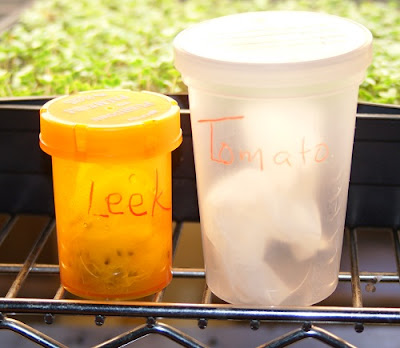
After I wrote my last post I started germination tests on several different seeds.
Of greatest concern were the snap peas. I have lots of seed in two different containers and no idea when I bought them.
Germination was successful, with a high percentage for both batches of peas. Yes! I will have snap peas again... barring a horrible infestation of cutworms, such as took out my peas two years in a row several years ago. The peas were the first seeds to send out a radicle.
The Roma II bush beans also germinated successfully, taking a couple of days longer than the peas.
The leeks also showed nearly 100 percent germination. Since it's about time to start my leek plants, I'll go ahead and plant these little seeds. The leek seed was purchased in 2019, and supposedly leek seed has a life expectancy of only a couple of years, which is why I tested it.
The Brandywine tomato looks iffy. So far only two seeds out of probably 30 are showing signs of life. I'll give them a few more days.
The celery test must start over. Because I thought celery seed needs light to germinate, I put the damp coffee filter with the seeds out flat an stuck in a plastic bag. I forgot to check them for a couple of days and today they were dried out. So, start over. Apparently celery can take two to three weeks to germinate, although I don't recall it ever taking that long when I planted it in soil. Do I want to mess with getting new seed or just take my chances? I don't want to wait three weeks to order seed.
Decisions, decisions.
That wraps up the necessary germ tests, more or less. I think I'll probably order more Brandywine tomato seed, unless the germ tests gets radicles soon.
I have some other old seeds earmarked for testing, but that will just be to satisfy my curiosity as these are not seeds I'll replace. One packet contains five-year-old purple haze carrot seeds. I didn't care for the way they grew, but I'm curious if carrot seed that old will germinate. I'll test some seven-year-old jalapeno seed and eight-year-old cayenne seed. I only need two or three plants of each, so I've just been buying plants instead of starting them. Plus I have some six-year-old Oranglow Watermelon seeds that I collected from watermelons growing in my garden. Not sure if I'll plant any if they still germinate, but I'm curious. Science, you know.
I'll let you know how things go.

It's that time of year again. I'm thinking about seeds, seeds, seeds.
Seeds are incredibly amazing beings. Each seed, no matter how tiny, is a miniature plant curled up inside a protective shell. Each seed has a tiny root (radicle), a stem (hypocotyl), and miniature seed leaves (cotyledons).

At left is a little drawing I did of the interior structure of a seed. The green part is the cotyledons, seed leaves, that contain food to nourish the little seedling once the seed coat cracks.
Although the seed appears to be sleeping, lots of enzymatic and chemical actions take place to prepare the seed to germinate and grow.
No matter how tiny the seed is, it contains the same structure and processes as much larger seeds, like that avocado pit you just tossed into the compost bucket.
The seed waits for the right conditions -- the proper amount of moisture absorbed, the appropriate soil temperature, and who knows what else the seed is waiting for that will disintegrate the germination inhibitors that all seeds contain. All seeds and/or the fruits they form within, contain germination inhibitors, otherwise they might germinate at a time or place the seedling cannot survive. When the germination inhibitors are gone, the radicle is the first to emerge, digging into the soil. Then the little seed leaves unfurl, soaking up sunlight. And you have a plant.
The photo at the top of this post is of the refrigerator drawer where I store my seeds. When stored in proper conditions seeds can remain viable for quite some time. Just how long seeds remain alive depends on what plant they come from. Melon seeds, for example, remain viable for much longer that seeds of leeks and onions. So I can stock up several years worth of melon seed, but only a couple of years' worth of leek and onion seeds. However, seeds will survive past the expected life expectancy when stored properly. According to "The Seed Garden," published by the Seed Savers Exchange, okra seeds have a life expectancy of just two to three years. Yet I had 10-year-old okra seeds germinate almost 100 percent. Then we have ancient varieties of beans and squash that germinated after thousands of years in buried clay pots. Some of these, such as the "Cave Bean" featured in Baker Creek Heirloom Seeds catalog, have been propagated and shared, reviving those old varieties.
None of the seeds in my refrigerator drawer are thousands of years old, or even 10 years old, but some are six or seven years old.
Tonight I started germination tests on some of the older seed so I know whether I need to replace it, or whether I can plant it for another season. A germination test is pretty simple. Basically, you need water, a paper towel, and seeds. Here are step-by-step instructions and pictures on a blog post I wrote for our Extension Master Gardeners' Web site.


But it wasn't enough.
It wasn't enough, I kept thinking.
I've got to do more.
All the doom and gloom stories I read about climate change just made it worse. I quit reading them. Unless a headline indicated I might get helpful information about, or contained something positive, I didn't read them. I already know it's bad.
That didn't help much. The funk remained.
I tried writing about my funk in a journal. That helped some, but not enough.
I kept reading things that said, "Plant trees."
"Plant trees."
That was at least part of the solution.
Plant trees.
I can plant trees.
So planting trees became my personal "save the world" project.
I didn't go out and buy a bunch of trees, though. I bought a few, but they weren't necessarily part of my save-the-world project. Instead I planted seeds and started digging up seedlings the squirrels had so generously planted in my garden.
The fact that I collected the seeds of some of these trees myself made this project more than a save-the-world project. It is quite fun. Many of my little trees also will eventually provide food for me, and, without a doubt, for wildlife.
Paw paws and persimmons were the first seeds planted. I had received paw paws to eat at a music festival and saved the seeds. Later I received seeds from local paw paws. At the same festival I found an American persimmon tree full of ripening fruit, ate some fruit and saved the seeds. I also dug a couple of little chinquapin oak seedlings some generous squirrels had planted in the garden.
My favorite bit about pretty much all of the trees in my little project is that they are native here. I may be at the far western edge of the range for persimmons, but I am not that far west of the area where I found the fruiting tree.
The site where I planted the paw paws isn't ideal, but I do have a grafted tree that I planted seven or so years ago that appears to be doing well there. It has not provided fruit because the few paw paw trees I've seen in the woods seem to have died, and the pollinators for paw paws, which are flies instead of bees, are not terribly efficient. However, this year my paw paw produced three little fruits on a puny branch at the bottom of the tree. You can bet I saved and planted the seeds.
Likewise, my site isn't ideal for persimmons, but that's never stopped me with anything else. American persimmons (a Chinese persimmon also exists) are dioecious, meaning that male flowers grow on one tree and female flowers grow on another tree, so you need both female and male trees to get fruit. Except when you don't. I have a young grafted persimmon that is a self-fruitful variety. And sometimes a tree will produce "perfect" flowers, meaning that one flower has both male and female reproductive structures. Apparently a tree of one sex also might suddenly start producing flowers of the other sex. So they seem a bit "gender fluid."
The persimmons you find in grocery stores are invariably of the Chinese species, as the fruit is much larger than that of the American species.
Until this year I've only relocated chinquapin (also spelled "chinkapin") oak seedlings rather than planting the acorns myself. However, a couple of months ago I found several dozen little acorns lying on the road and gathered them up. I don't think I stored them properly, though, as when I cracked on open to test the flavor it was hard and dry, but tasty still. I think I should have put them in a plastic bag in the fridge instead of in a paper bag. They might not be able to grow, but I planted some anyway. I will crack open the rest and maybe soak them or grind them before eating. All acorns are edible, but require a leaching process to remove the excess of tannins. However, chinquapin acorns contain far less tannin and can be eaten without leaching.
To plant the tree seeds I filled gallon-size pots with wet potting soil and pushed the seeds in about an inch (two centimeters) deep, ideally one seed to a pot. However, I put two or three seeds in each pot because I know some might not germinate. The pots live on the north side of the house, which allows the seeds to experience the natural freezing and thawing of winter. This enhances germination. I will water them periodically to keep everything moist and may devise covers for them to help prevent drying. Soaking them prior to planting might help, but I'm not in a hurry for them to sprout.
Seeds I planted three years ago no longer live in pots. At some point they all graduated to five-gallon buckets with holes drilled in the bottom, because I wasn't ready to plant them after a year. Initially I wanted to plant them out last fall. That didn't happen. Then I wanted to put them out this spring.
That didn't happen, either. However, they got planted this fall. Ta da! Most of them were surrounded by chicken wire, even though the area they were planted in is surrounded by concrete reinforcing wire. Rabbits, which will eat little seedlings, can get through the six-inch squares of the taller fencing, and the chicken wire will keep them out.
Now I just need to keep them watered, and maybe provide a little shade for the baby paw paws this coming summer.
I have no illusions that my little project will have a huge impact on climate change, but every little bit helps. We've lost half of the world's trees in the past century as jungles and forests were/are cleared for agriculture, industrial uses and the spread of towns and cities. Everything helps.
Tropical zone trees suck up far more carbon than temperate zone trees, but I live in a temperate zone. To "plant" trees in the equatorial area I have donated to a fabulous organization called Tree Sisters. They not only plant trees, but work with local populations to make sure the trees are cared for, which often means providing assistance that enables them to support themselves without cutting down trees, or teaching them to properly manage their use of trees. In some areas, their programs also empower women. You can make a one-time donation, or set up a monthly donation. Check them out and plant some trees. Future generations thank you.
 |
| The beautiful arch-trellis my husband built for me as an entrance to the garden. Loofa gourds, bitter melon and malabar spinach climb either side, with giant loofa gourds hanging inside. |
Even though the grass sparkled with frost, the temperature had not fallen below the freezing point. Here the National Weather Service explains how we have frost without freezing temperatures. So the following day nothing appeared to have changed. But a real freeze arrived a little more than a week later and I was glad to have preserved these last bits of summer.

I thought surely the frost would take out the eggplants, even if it didn't freeze. However only the tops were a bit burned and I cut a few more small eggplants a few days later.
I also picked a few more Sun Golds later. Some of the peppers are still in my refrigerator's vegetable drawer.
I also filled a couple of vases full of flowers -- zinnias, marigolds and a few snapdragons. But I couldn't save them all. So here are a few. (The snapdragons are still going, even after yet another freezing night.)


